
• Please review our updated Terms and Rules here

Remake RAM-Disk for the PX4 (and PX-8) project

fjkraan

Experienced Member
Joined
Jul 30, 2003
Messages
234
Location
Netherlands
A project more than three years in the making, and finally something to show.

The Non-Intelligent RAN Disk is a 120k Byte battery back-upped RAM disk for the Epson PX-4 and PX-8.
Unlike the Intelligent RAM Disk, which is (Z80) CPU based and works via commands, the Non-Intelligent
RAM Disk is I/O-register based. The only complicating feature is that the lower address byte has a
auto-increment function, implemented in a custom Epson chip.

At one time, a 512k Byte RAM Disk was created, lacking the auto-increment feature
(https://electrickery.nl/comp/px8/512kByteRAMDisk.html). This meant the
OS-ROM had to be patched, both for the larger size and the increment feature.

The current implementation works with the standard OS-ROM, and uses two GALs for addressing,
timing and the auto-increment. The board is prepared to connect three additional 128k Byte RAM
chips to enlarge the RAM Disk size. This requires patching CP/M at startup and might be done with
some User-BIOS code.

The RAM-Disk is currently only tested for the PX-4, but should also work for the PX-8.

The project is still very incomplete, it will take some time to complete testing and sweeping some of the
more embarrassing mistakes under the carpet.

GALs are vintage, but still available cheap in small quantities. 128k Byte NVRAM could solve the
battery problem but those are still surprisingly expensive (for a few).

Greetings,
Fred Jan
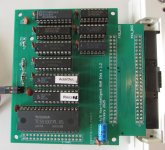
NIRAMDiskV1.2.jpg
 
Nice!

For the auto incrementing in particular you could use those old 74xx counter chips that can load any value, if you would want to do it without GALs. Not sure if those are still in production though?

How is the availability and price level of 5V 128kbyte SRAM chips v.s. using level converters with 3.3V chips?

It's probably much a matter of taste, but if the project can be done with SMD parts for the really common parts you can probably save both PCB space and assembly work by having those be assembled by the PCB manufacturer.
 
For the auto incrementing in particular you could use those old 74xx counter chips that can load any value, if you would want to do it without GALs. Not sure if those are still in production though?
Not being a TTL-wizard, it would be interesting to see how much TTL it would require. I just guessed it would be significantly more than two 24-pin GALs. There is a page with the current schematic, GAL-equations and description: newRAMDisk. I would like to keep board size under 100x100mm, that is much cheaper.
How is the availability and price level of 5V 128kbyte SRAM chips v.s. using level converters with 3.3V chips?
Apparantly 5V 128kx8 SRAM is still cheap, comparable to 3.3V variants. I'll try with a battery otherwise the Dallas DS1245Y looks (sometimes) like a affordable alternative.

Currently trying to optimize the circuit a bit before publishing PCB files. I do not plan to sell boards.

Greetings,
Fred Jan
 
It would likely be a lot more chips. I would think that for example a 74xx161 or 163, or 191/193, or 197 if those are more readily available, would work as counters. Each chip are four bits, so you'd need two chips for the low address byte rather than a single eight bit latch/d-flop. Not that much more, but then there is all the glue logic too. And if the idea is to make it cheaper/easier to produce then there is the question of which chips will be available in the near future.

It would be interesting to know how many PX4 and PX8 were sold and how many ram disks were sold.

Going off on a tangent, I would think it would be really easy to implement an external disk drive emulator using a modern microcontroller. IIRC it uses 38400bps or maybe it's 19200bps regular RS232 to talk to disk drives, and there is a PC DOS program that acts as an emulator.

I have a PX8 (that I really need to take the time to check if the small battery have leaked... I didn't think about that, and to make things worse it's been stored easily accessible over all the years, so I would just had had to plug in the power supply every now and then to avoid any catastrophy...
Anyways, I think I burned a few EPROMs with for me more interesting software than the word processor or whatnot that came with the PX8. IIRC I burned a few EPROMs with Turbo Pascal and related utilities or whatnot. IIRC it's possible but fiddly to install EPROMs without the plastic carrier.

Two project suggestions for anyone reading this:
3D print model for the plastic carrier for EPROMs (and possibly also the small storage case for the EPROMs)

Replacement thingy that can be installed in the EPROM socket(s) that let you switch between different images. Basically just a larger EPROM (or rather EEPROM/flash) and some way to set the higher address bits.
Can't remember how the address decoding and whatnot works - if it's possible to add a write line then it would be a cool idea to use EEPROMs and make them writable. IIRC they already contain regular CP/M file systems (but I might misremember). If so writing seems at least not fully unreasonable.

Feature creep idea for your RAM expansion: Socket for an EEPROM, with the ability to write EEPROMs that then can be used in the internal EPROM sockets.
 
Some of your ideas are already implemented:
The ROM capsules are cool, but when you have the RAM Disk and the disk drives (also exists in emulated form, both diy and sold), the ROMs become less important.

On the sales figures of the PX-8 and PX-4, I have no clue. They were more intended for the professional market, not consumers/hobbyists. But at some time the PX-8 was somewhat popular when the DAK-ROM appeared.

Greetings,
Fred Jan
 
Yeah, the use case for the ROM modules seems to mostly be to have them as separate drive letters, perhaps? And also they must had been way cheaper than the ram expansion back in the days. Also they were probably a mechanism to make it harder to do "unlicenced copying" slightly harder.

Oh, so that's your site, cool!
I'm 99.9999% sure that it was that site I learned things from when I burned eproms for my PX-8 many years ago. IIRC the part about EEPROMs wasn't there at the time (15-20 years ago?) and/or I just forgot about that since I didn't have any EEPROMS but had EPROMS at the time. Perhaps. :)

The dial-a-rom seems like a neat solution!
 
Back
Top